Commercial Water Softening Resource Hub
Use this resource center to understand commercial water softening, compare system configurations, prepare sizing information and access brochures, drawings and application guides. Culligan Texas can help facility managers, engineers, contractors and business owners across Texas select a system around actual water quality, flow and operating requirements.
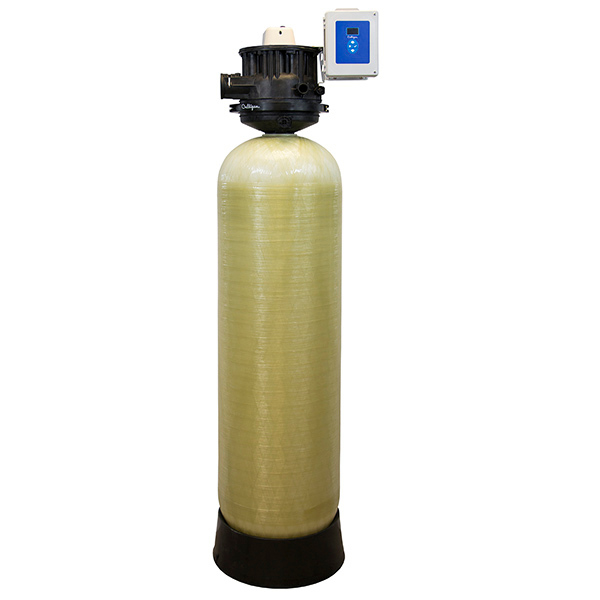
Commercial Water Softening at a Glance
Commercial water softeners use ion exchange to reduce calcium and magnesium hardness. By controlling hardness, a properly applied system can help limit scale in boilers, water heaters, dishwashers, laundry equipment, cooling systems, plumbing and downstream RO equipment. In much of North and Central Texas — where limestone-influenced supplies commonly run hard to very hard — softening is often the first treatment step a facility considers.
The correct solution may be a compact simplex softener, a duplex alternating system, a high-flow multi-tank arrangement, a progressive-flow design or a custom skid-mounted package. Selection depends on peak GPM, daily gallons, hardness, operating schedule, pressure and redundancy. For the full sizing method, see How to Size a Commercial Water Softener.
Guides, Drawings and Documents
Culligan Texas maintains selection guides, sizing worksheets, configuration comparisons, pretreatment guides, service checklists and equipment submittals for commercial softening projects. Two libraries are available online today:
- CAD Drawings and Equipment Submittals — drawings for specification and design work.
- Case Studies — real installations organized by industry and treatment objective.
For a sizing worksheet, configuration guide, pretreatment guide, maintenance checklist or capabilities brochure, tell us what you’re working on — include your company, application, estimated flow, city, project stage and the document you need, and the team will send the right materials.
Choose a Resource by Application
- Boiler makeup: Learn how hardness, alkalinity and dissolved solids influence scale, blowdown and treatment selection in the Boiler Feedwater Treatment Guide.
- Cooling towers: Understand when softening can increase safe cycles of concentration in the Cooling Tower Water Treatment Guide.
- Hospitality and food service: Protect hot-water equipment, dish machines, laundry systems and fixtures while supporting consistent cleaning results — see Hotels and Restaurants.
- Healthcare: Use softening as part of pretreatment for RO and critical-water systems where appropriate — see the ST108 guide and Hospitals.
- Manufacturing: Protect process equipment, rinses, heat exchangers and downstream high-purity systems — see Industrial Manufacturing.
- Car washes and laundries: Improve detergent performance and reduce hardness deposits on equipment and finished surfaces — see Car Washes.
Choose a Resource by System Configuration
| Configuration | Best For |
|---|---|
| Simplex | Facilities with a defined regeneration window or acceptable bypass conditions |
| Duplex alternating | Uninterrupted softened water — one tank in service while the other regenerates or stands in reserve |
| Triplex / multi-tank | Higher flow, redundancy and flexible sequencing for large facilities |
| Progressive-flow | Variable demand — tanks enter service as flow rises, using capacity efficiently |
| Skid-mounted | Fast installation, repeatable designs or temporary deployment |
Need Help Finding the Right Document?
Culligan Texas can review project requirements and provide equipment information, water testing and design support. For final selection, our application engineering team will need current water quality, flow and site data — contact us with your company, application, estimated flow, city and project stage.
Frequently Asked Questions
What information is needed before selecting a commercial softener?
A water analysis, peak GPM, daily gallons, operating schedule, pressure, pipe size, site dimensions, drain and power information, and redundancy requirements are the best starting points.
Can I download CAD drawings?
Yes — visit the CAD Drawings library, or contact us for a specific model or product family.
What is the difference between simplex and duplex?
A simplex system has one treatment tank. A duplex alternating system can maintain softened water availability while one tank regenerates or remains in reserve.
Is softening used before RO?
It is commonly used when hardness scaling is a concern, but pretreatment should be selected from the feedwater analysis and RO design.
Can Culligan Texas help with specifications?
Yes. The team can provide equipment information, application support and project-specific recommendations after reviewing the water and operating requirements.
Are brochures a substitute for engineering review?
No. Brochures provide general capabilities and model information. Final selection requires project-specific technical review.
Related Resources
Already a Culligan Texas customer? Request service or a system inspection.
