Commercial Water Softener vs. RO vs. DI: Which System Do You Need?
Water softening, reverse osmosis and deionization solve different water-quality problems. A softener primarily targets hardness. RO reduces a broad range of dissolved contaminants through membrane separation. DI removes charged ions to produce low-conductivity or high-resistivity water. Many commercial and industrial systems use two or all three technologies in sequence.
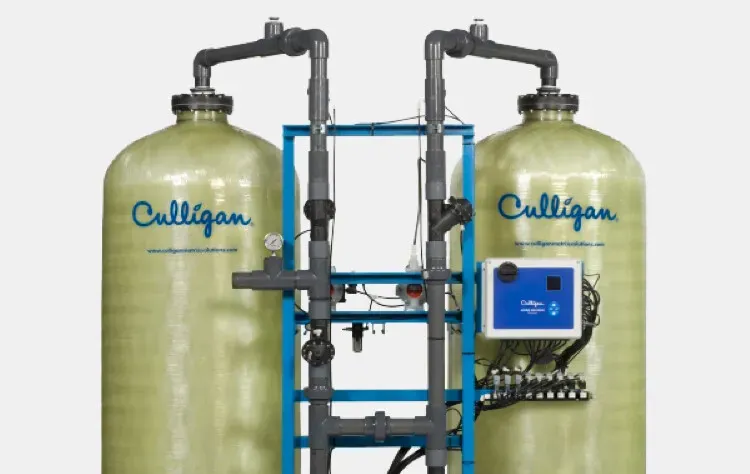
Treatment Comparison at a Glance
| Technology | Primary Purpose | Commonly Targets | What It Does Not Automatically Solve | Common Uses |
|---|---|---|---|---|
| Water Softening | Hardness control | Calcium and magnesium hardness | Broad TDS removal, microorganisms, all organics | Boilers, hot-water systems, laundries, dishwashing, RO pretreatment |
| Reverse Osmosis | Broad dissolved-solids reduction | Many dissolved salts, ions and selected other contaminants | Every dissolved gas, all microorganisms without system controls, final ultrapure polishing | Process water, boiler makeup, food and beverage, healthcare, reuse |
| Deionization | Low-conductivity / high-resistivity water | Charged dissolved ions | Particles, many uncharged organics, microbiological control by itself | Labs, electronics, precision rinsing, high-purity process water |
What a Commercial Water Softener Does
A commercial softener uses cation-exchange resin to replace calcium and magnesium hardness ions with sodium or potassium ions. It is selected primarily to control hardness scale and improve the performance of water-using equipment — a frequent first step on the hard supplies common across North and Central Texas.
Softening does not remove total dissolved solids in the same way as RO, and softened water is not the same as deionized water. The dissolved minerals have been exchanged, not broadly separated from the water.
What Reverse Osmosis Does
RO uses pressure and a semipermeable membrane to separate water from a concentrated reject stream. It can reduce a wide range of dissolved salts and other contaminants, depending on membrane type, feedwater composition and system design.
RO normally requires pretreatment to control sediment, oxidants, hardness or other fouling and scaling risks. It also creates a concentrate stream that must be included in the facility’s water balance.
What Deionization Does
DI uses cation and anion exchange resins to remove dissolved ions. It is commonly measured by conductivity or resistivity and is used where mineral ions could affect rinsing, chemistry, product quality or sensitive equipment.
DI is highly effective for ionic contaminants but is not a complete barrier to every uncharged organic compound, particle or microorganism. High-purity systems may combine RO, DI, UV and final filtration.
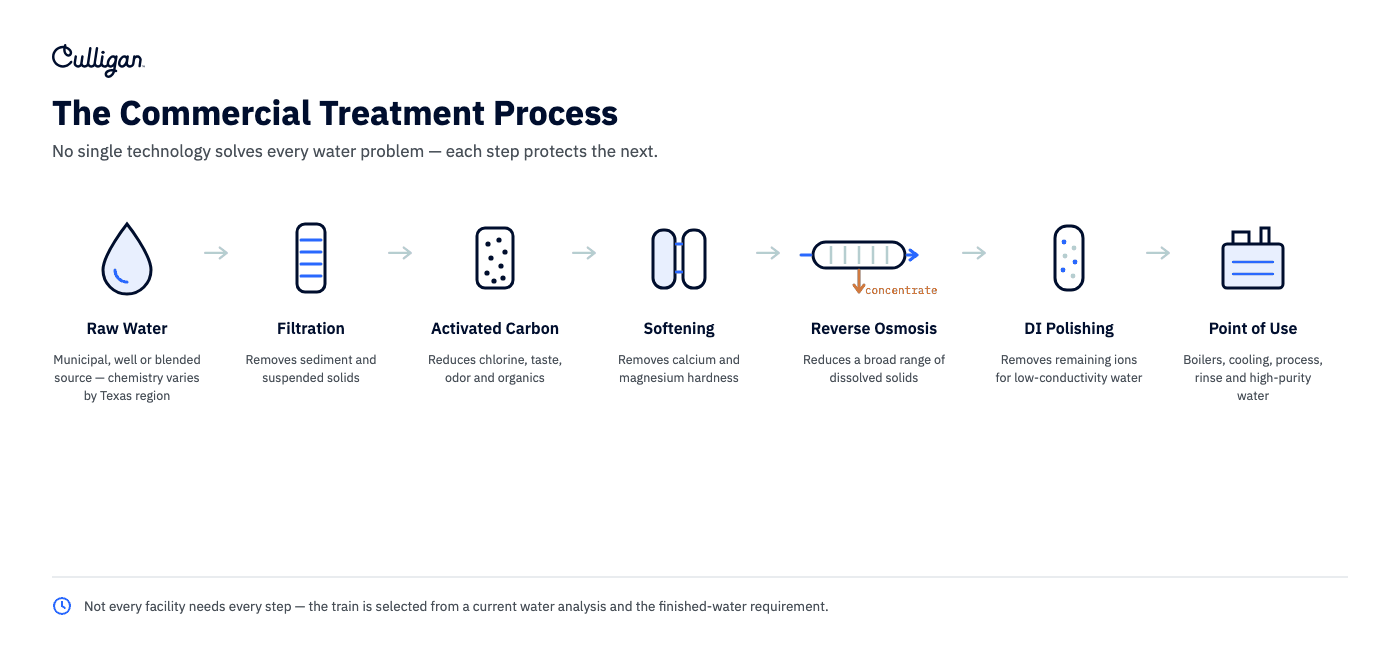
When the Technologies Work Together
- Softener + RO: Softening can reduce hardness-scaling risk before the RO. The RO then lowers dissolved solids for process, boiler, food, beverage or other applications.
- RO + DI: RO removes most of the dissolved load, and DI polishes the RO permeate to a lower conductivity or higher resistivity. This can extend DI resin life compared with treating raw water directly.
- Softener + RO + DI: A complete treatment train may use filtration and softening as pretreatment, RO as primary dissolved-solids reduction and DI as final polishing.
- Carbon + RO or DI: Activated carbon may be used to reduce chlorine or organics where required by membranes, resin or the process.
How to Choose
Choose based on the water problem and the required finished-water quality. If the main goal is hardness-scale control, softening may be the appropriate treatment. If the process requires broad dissolved-solids reduction, RO may be needed. If the target is very low conductivity or high resistivity, DI or RO followed by DI may be appropriate.
A current water analysis and a written product-water specification prevent over-treating or under-treating the supply — and in Texas the analysis matters twice over, because the answer genuinely differs between the hard limestone supplies around Dallas and Waco, the variable Gulf Coast blends around Houston and the high-TDS groundwater in parts of West Texas. The design should also account for flow, daily volume, operating schedule, wastewater, storage, maintenance and redundancy.
Get a Process Recommendation
Culligan Texas can test the source water, review the process requirements and recommend a treatment train that balances water quality, reliability, serviceability and operating cost.
This comparison is a planning tool. Final process selection should be based on a current water analysis, a written finished-water specification, verified flow and usage data, site conditions and a project-specific engineering review.
Frequently Asked Questions
Is softened water the same as RO water?
No. Softening exchanges hardness ions but does not broadly remove dissolved solids. RO separates a large portion of dissolved salts into a concentrate stream.
Is RO water the same as DI water?
No. RO is membrane separation, while DI is ion exchange. They can produce different purity profiles and are frequently used together.
Which system is best for a boiler?
The correct treatment depends on boiler pressure, makeup-water chemistry, condensate return and operating goals. Softening, dealkalization, RO or DI may be used individually or together.
Does DI remove bacteria?
DI is designed to remove ions. Microbiological control requires appropriate system design, sanitization, UV, filtration or other measures based on the application.
Can a water softener reduce TDS?
A conventional sodium-cycle softener generally exchanges ions rather than significantly reducing the total amount of dissolved material.
How do I know which system I need?
Start with a water analysis and a clear finished-water specification. Then evaluate flow, volume, operating hours, wastewater, storage and redundancy.
Related Resources
Already a Culligan Texas customer? Request service or a system inspection.
